
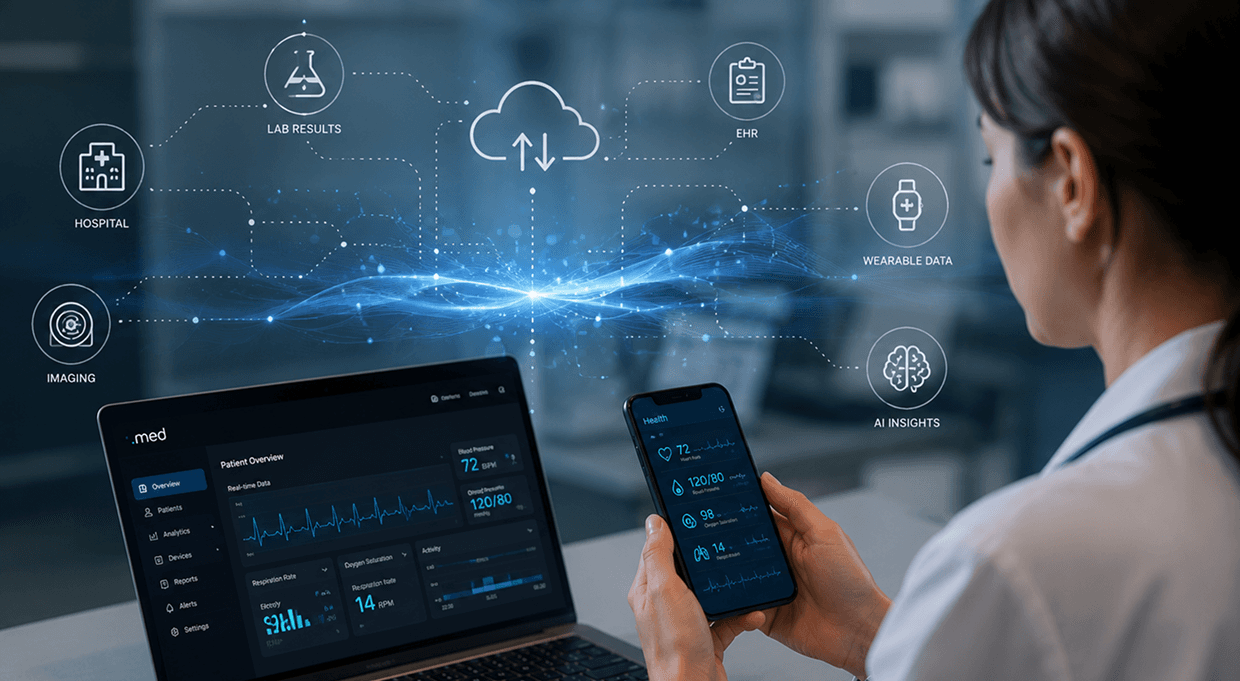
We've officially passed the era where a sleek, high-tech health wearable is enough to turn heads. Today, the world doesn't need another isolated gadget collecting numbers in a vacuum. The real battleground for modern medicine isn't the hardware on a patient's arm—it's the fluid journey of the data it creates.
Welcome to the age of data liquidity, the clinical capability transforming how we think about connected care.
The Data Trap: Connected vs. Liquid
For years, the med-tech industry celebrated “connectivity.” We successfully built devices that talk to apps via Bluetooth, and we digitized health systems with Electronic Health Records (EHRs). But let's be entirely candid: a system can be technically connected while remaining functionally useless.
When data arrives at a clinic incomplete, inconsistently structured, or trapped inside a proprietary dashboard, it creates an operational bottleneck. Clinicians don't have time to cross-reference five different screens just to figure out a patient's biometric trend.
- Connectivity is simply about whether System A can technically transmit a file to System B.
- Data Liquidity is the practical ability to find, access, standardize, and securely move clinical data across systems and workflows without delays, formatting hurdles, or manual workarounds.
When health data becomes liquid rather than static, it transitions from a passive historical log into a live tool for active, real-time intervention.
Fueling the AI-First Hospital
The push for liquid data has taken on massive urgency because of the acceleration of clinical AI. Artificial intelligence is an incredible tool, but it is deeply hungry for high-fidelity, structured fuel.
Without clean, continuous physiological telemetry flowing fluidly from devices into predictive analytics pipelines, AI models are essentially guessing. But when a device—like an invisible, clinical-grade continuous biosensor—feeds structured data seamlessly into an integrated health ecosystem, the entire care loop changes.
The Shift in Action: Instead of reacting to a dangerous out-of-range health event after it happens, predictive algorithms analyze continuous telemetry to flag micro-biometric anomalies days before a clinical crisis occurs.
This liquid workflow dramatically minimizes diagnostic timelines and actively mitigates alarm fatigue—a major culprit behind clinician burnout—by filtering out noise and elevating only actionable, high-priority insights.
Dismantling the “Data Islands”
Achieving this fluid state requires breaking down legacy data islands through universal protocols and open architectures.
- Universal API Standards (FHIR & HL7): Modern med-tech platforms prioritize Fast Healthcare Interoperability Resources (FHIR). By organizing health profiles into small, reusable digital “resources,” platforms ensure that data maintains its exact semantic meaning whether it's sitting in a consumer app, a smart insulin pump, or an enterprise EHR.
- National Infrastructure Frameworks: Frameworks like TEFCA (Trusted Exchange Framework and Common Agreement) have rapidly scaled into vital national infrastructure. By facilitating the secure exchange of hundreds of millions of clinical records across disparate networks, these frameworks prioritize zero-friction data availability for both patients and providers.
Real-World Outcomes: Human Impacts
When we look past the engineering matrix and the regulatory acronyms, data liquidity is fundamentally about human outcomes.
It means a patient managing a chronic condition can go for a run or work out, clear their mind, and trust that their clinical-grade sensing is working quietly in the background. It means their care team will automatically receive actionable trends if something drifts out of bounds, without the patient ever needing to log a spreadsheet, print a report, or play telephone with a clinic coordinator.
The future of healthcare doesn't belong to the company that manufactures the most advanced standalone device. It belongs to the ecosystem that allows data to flow fluidly across institutions, informing sharper clinical decisions every single step of the way.
